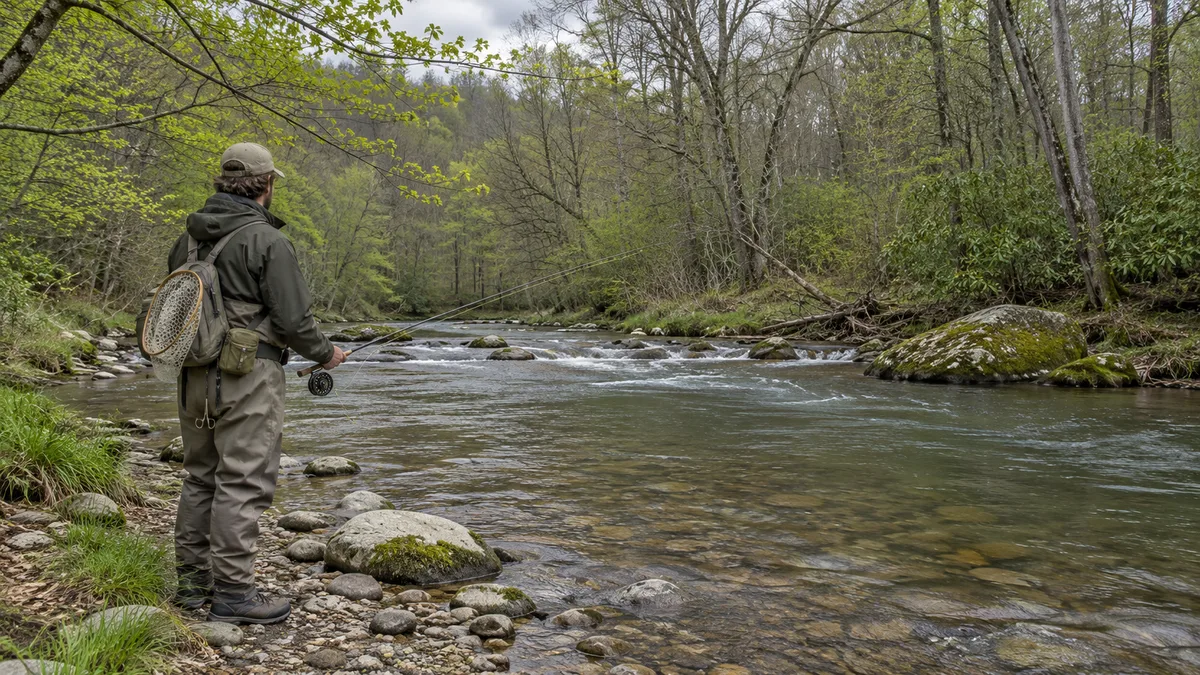
To fish a stocked trout stream for the first time, choose a legally accessible section, check its current rules and begin from a safe bank. Look for a pool or a quieter pocket beside moving water, then make short casts with a permitted lure or bait. A stocking report can help you select a stream, but it cannot tell you exactly where the fish are or promise a catch.
Find the right section before you leave
Search the state directory or stocking finder and follow the record to its agency source. Match the stream name and county, then look for the section limits: a named stream can cross several properties or have different rules upstream and downstream. A planned date can change; a completed report is a record of past activity. Neither establishes that every bank is open to the public.
Use the managing agency’s maps and notices to identify a lawful entrance, parking and the length of water you may fish. Easements, public land and private-property boundaries differ. A bridge or roadside pullout does not automatically give access to the bank. If the map is unclear, ask the land manager before entering. Our public-access guide walks through those checks.
Read the current season, license and trout-permit requirements, legal hours, harvest limits and tackle restrictions for that exact section. Some waters require catch and release or limit bait, lures or hooks. A stocking date does not override those rules. Check temporary closures, weather and local water conditions again before travelling.
Bring a small stream-fishing kit
A light spinning or spincast outfit is enough to begin; you do not need to learn fly fishing first. Use line and tackle suited to the stream, your experience and the current regulations. Oregon’s trout guide offers a light rod, 4- to 6-pound-test line and small lures as a general starting point, not a requirement for every water.
Pack a few items rather than every lure in the shop:
- A small spinner or other legal artificial lure, and a legal bait-and-float option if you prefer and the rules permit it.
- A few appropriate hooks and small weights, with pliers or a hook-removal tool.
- A soft, knotless or rubberized net if you may release a fish.
- Your required license and permits, water, weather layers, a charged phone and a litter bag.
- A cooler with ice if you plan to keep a legal catch.
Before casting, check the trees, bank and people behind you. Carry hooks and lures securely between spots. The broader beginner’s guide covers basic equipment for ponds as well as streams.
Read the water: pools, runs and pockets
Pause at the bank and watch the current. New York’s stream-trout guide describes several useful features:
- Pocket: a small sheltered area behind a rock or other current break. Try the edge where faster and slower water meet.
- Pool: a deeper, slower stretch. The moving water entering the pool, its deeper middle and the shallower tail are all worth observing.
- Run: a flowing section that is generally deeper than a rapid and shallower than a pool. Rocks, logs and other cover can create seams in its current.
These are places to explore, not guarantees. Stocked fish may move, spread out or be difficult to see, and conditions vary from one stream to another. Start with a spot you can reach without entering unsafe water, and give other anglers room.
Try a controlled drift or a small lure
If bait and a float are legal, attach a suitable hook, a small weight and a float above it. Cast a short distance upstream of a calm pocket or along a seam, and let the current carry the float naturally through the target area. Keep enough contact with the line to notice a bite without pulling the float abruptly across the current. Retrieve before it reaches a snag or another angler’s line. Adjust the depth and weight for the water; avoid dragging the hook across the bottom.
Where artificial lures are legal, a small spinner is another simple choice. Cast slightly upstream into open water, take up slack and retrieve with control as the lure moves through the current. Oregon’s agency suggests keeping excess line off the water during the drift. Begin with short casts and change position or retrieve speed if needed. Do not cast into vegetation, private property or a crowded section.
Walk and fish gradually upstream where access and conditions allow. New York DEC recommends a quiet approach because trout often face into the current. Stay back from the edge when possible and make a few casts before moving. If a spot is occupied, ask where the other angler is fishing and leave enough space for both lines; our etiquette guide has more on sharing a busy water.
Treat moving water seriously
You can have a useful first trip without wading. Wet rocks, sudden drop-offs, cold water and slippery banks are difficult to judge; choose shore fishing or leave if you cannot assess the footing and current. Check for rain upstream and possible dam releases, and move to higher ground if water rises. The National Weather Service warns that even shallow, fast-moving floodwater can knock an adult over; do not walk or drive through flooded crossings.
Tell someone where you plan to go, and consider fishing with a companion. The U.S. Fish and Wildlife Service recommends a Coast Guard-approved life jacket when wading. Wear suitable footwear and avoid taking a cast that places you near an unstable edge. See the trip checklist for more preparation.
Decide how you will handle a trout
If release is required or you choose to release the fish, wet your hands, keep it in the water as much as possible and remove the hook promptly. Avoid touching the gills or placing the fish on dry rocks. For a deeply swallowed hook, the U.S. Fish and Wildlife Service advises cutting the line close to the mouth instead of tearing the hook out; follow local requirements and the agency’s current guidance. If harvest is legal and intended, follow the limits and keep the fish cold.
Leave the bank cleaner than you found it. Pick up loose line and tackle, and clean mud and plants from boots and gear before visiting another water. Follow the local agency’s cleaning, draining and drying instructions to reduce the risk of spreading aquatic invasive species.
Common questions
When is a good time to fish a stocked stream?
Choose a legal fishing period with safe access and comfortable water conditions. A recent stocking report can help you plan, but the best time varies with the stream, weather and fishing pressure. Check the forecast and the agency’s latest report rather than assuming that the first morning after stocking will be best.
Warm water can stress trout, particularly when they are caught and released. New York DEC recommends avoiding catch-and-release trout fishing in warm-water conditions. Check the local agency’s temperature guidance and any temporary closures, and make a different plan when conditions are unsuitable.
Is the stocking point the best place to fish?
It can be a starting point if access is legal, but fish can move and stocking records may describe an entire section rather than a precise release location. Explore permitted water and check the date and wording in the agency report.
Can I use worms in every stocked stream?
No. Some sections restrict natural or scented bait, especially during special-regulation periods. Check the current rules before choosing bait, hooks or lures.
Do I need waders?
No. Many anglers fish from an accessible bank. Waders do not make a strong current safe; use the bank or choose another location when conditions are uncertain.
Choose a manageable first section, leave room for others and be ready to change plans if the water or weather is not safe. A well-planned visit is worthwhile even when the trout do not cooperate.
Sources & further reading
- New York DEC: Fishing for stream trout ↗
- Oregon Department of Fish and Wildlife: How to fish for trout ↗
- New York DEC: Being a responsible angler ↗
- U.S. Fish and Wildlife Service: A guide to fishing for the first time ↗
- National Weather Service: Flood safety ↗
- New York DEC: Clean, drain and dry equipment ↗
Agency information can change. Check the official page before travelling. Suggest a correction.