Before a trout fishing trip, verify the stocking information, the exact location and the current access and fishing rules. Then prepare for the conditions you will actually encounter. A recent stocking record is a starting point, not a complete trip plan.
Confirm the stocking information
Open the official source for your state and check the year or season. Identify whether the date is planned, reported completed, postponed or cancelled.
If the source gives a week, keep the full range. Look for notices or revised files. Save the agency link so you can revisit the information rather than depending on an old screenshot.
Use our stocking finder for imported records, then follow the source attached to the relevant row.
Match the water and section
Write down the water’s full name, county and managed section. Check the official map or access description before choosing a destination.
Do not assume a name match identifies the correct reach. Avoid selecting a parking or entry point from an unverified map pin, particularly when a water passes through private property.
Check current rules and access
Use current official information to confirm the license and permits required for your trip. Check open dates, gear restrictions, possession rules and any special program designation.
Review access notices independently from the stocking table. A planned release and an open parking area are different facts.
Prepare for the conditions
Check the current weather and relevant local water information before departure. Decide in advance which conditions would make you change the plan.
Pack clothing appropriate to the forecast, drinking water and the equipment needed for your chosen fishing method. Keep navigation and a communication plan appropriate to the area. Avoid assuming that a familiar spot has the same conditions as your last visit.
Pack a simple set of essentials
Use this as a personal packing prompt rather than a universal equipment prescription:
- License and any required permits.
- Rod, reel and tackle suited to the water and its current rules.
- Landing and fish-handling equipment appropriate to your plan.
- Weather layers, drinking water and food.
- Navigation, charged phone and a basic first-aid kit.
- A way to carry your litter and discarded line out.
Adjust the list to the location and trip length. If you need specialized gear or skills for a particular water, resolve that before travelling.
Choose a backup
Pick another suitable water or a different activity in case the schedule, access or weather changes. Keep the alternative’s source information too.
A flexible plan lets the stocking schedule inform your day without making it the only reason the day can work. For the most common timing traps, read when stocking schedules change.
Match the tackle to your fishing method
For a fly fishing trip, check that the rod, reel, fly line, leader and selected flies are compatible and appropriate for the rules. For spin fishing, check the reel, line and permitted lures or bait. Do not assume natural bait, a treble hook or scented tackle is allowed simply because a stream is stocked.
Inspect hooks and line before packing, and bring only the equipment you can use safely in that setting. Waders are not a requirement for every lake or pond trip, and carrying them does not establish that a particular river is safe to enter. A bank-fishing plan may be the practical choice.
A practical fishing trip packing list
For a short shore trip, keep your fishing gear simple and check that every item fits the local rules:
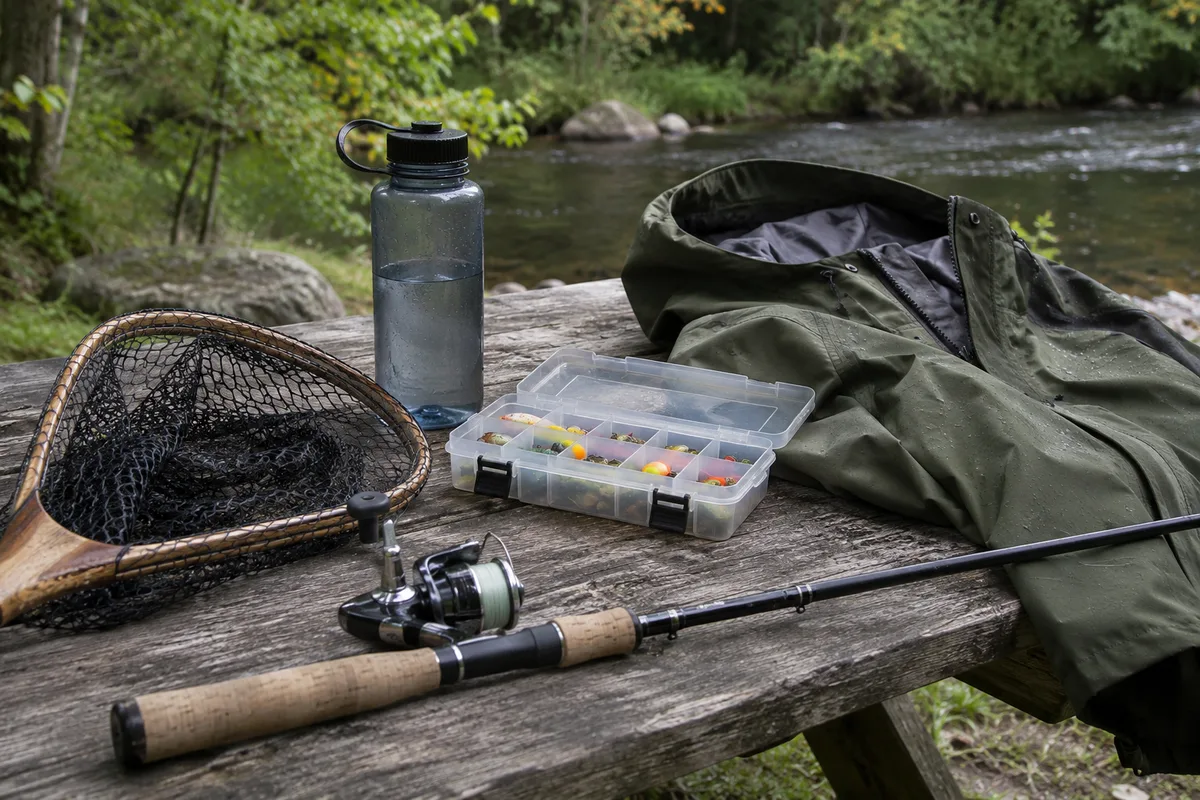
- Fishing supplies: rod, reel, line and a small tackle box with hooks and the lures or bait permitted at that water. A float, sinker or swivel can be useful for the setup you intend to use; bring spares you know how to rig.
- Landing and release: a landing net and pliers or another hook-removal tool. If you expect to release fish, the National Park Service recommends a rubber or soft knotless net, wet hands and keeping the fish in the water as much as possible.
- Clothing and comfort: boots with suitable traction, a rain jacket, layers, sun protection and polarized sunglasses. Put a dry layer and important items in a waterproof bag when conditions call for it.
- Food, safety and navigation: drinking water, food, a basic first-aid kit, a charged phone and an offline map or other navigation appropriate to the area. Tell someone where you plan to go and when you expect to return.
- If you plan to keep fish: bring a cooler and an appropriate way to keep the catch cold, after checking current harvest and possession rules.
You do not need every item for every pond or river. A multi-day trip, a remote hike or a fishing trip with children can call for additional supplies. Pack for the actual access point and forecast, rather than the stocking date alone.
Before wading or taking a boat
Check the forecast, water levels, current, bank conditions and local access notices. If you are unsure whether a crossing or shoreline is safe, choose another place to fish. For a boat trip, check the required safety equipment and the rules for that water; the U.S. Coast Guard recommends wearing a properly fitted life jacket while a boat is underway.
Final check before leaving home
Open the current wildlife agency schedule or stocking report one more time. Confirm the water, the meaning of its date and any changes. Put your fishing license and any required permit where you can retrieve them, check your itinerary, and choose a backup location. A revised schedule can affect the trip, but it does not automatically change the rules or access conditions at a site.
For a stream trip, use our guide to finding public fishing access to check the route, boundaries and parking for the exact reach.
Sources & further reading
- Virginia DWR monthly trout stocking schedule ↗
- Virginia DWR daily report and notices ↗
- WVDNR fish stocking information ↗
- Pennsylvania Fish and Boat Commission trout stocking ↗
- National Park Service catch-and-release guidance ↗
- U.S. Coast Guard boating safety questions ↗
Agency information can change. Check the official page before travelling. Suggest a correction.