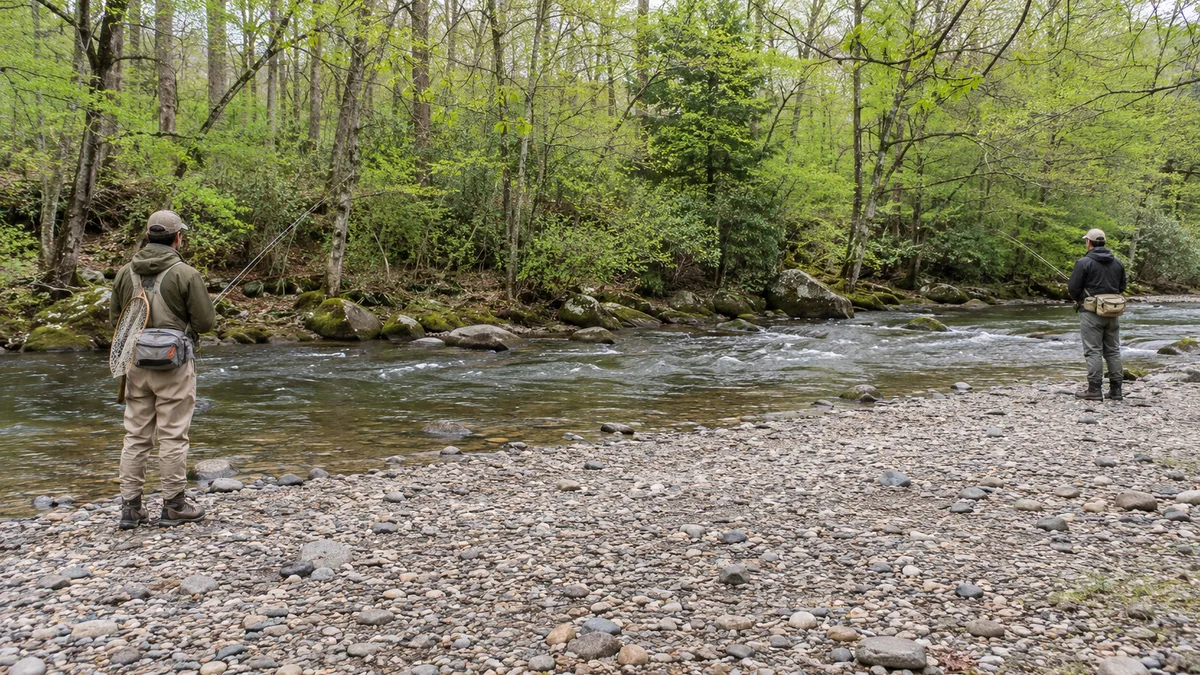
At a busy stocked trout water, give other anglers enough room to cast, watch where their lines are drifting and ask before stepping into a shared spot. Keep paths open, follow the rules for the exact water and take your fishing line and litter home. A little patience helps everyone enjoy a popular stream or pond.
There is no single distance that fits every bank or pool. Current, casting method, visibility, the number of visitors and the shape of the shoreline all affect how much space people need. If you are unsure whether there is room, ask or choose another place.
Before you set up: watch the water
When you arrive, pause for a minute away from the edge. Notice where others are casting, where floats or lures travel in the current, and how people enter or leave the bank. A space between two anglers may already be where their lines meet.
Choose a position that leaves room for your own backcast and keeps your hook away from people, pets, trees and roads. The U.S. Fish and Wildlife Service advises looking around before every cast. On a small pond, a shorter cast or a different part of the shore may be more considerate than trying to reach the farthest bank.
Keep tackle, chairs and coolers out of walkways, fishing piers and access routes. Leave room for other people to pass and for anyone using a mobility device to reach the water. If an accessible platform has posted rules or is reserved for particular users, follow the posted instructions.
How much space should you give another angler?
Give enough space that neither person has to change their normal cast or retrieve to avoid the other. A long fly cast, a bobber drifting downstream and a stationary bait setup each use space differently. Ask a neighbor which direction they are fishing if it is not obvious.
New York DEC recommends giving a stationary or slowly moving stream angler room and passing quietly outside the water where practical and permitted. Oregon’s steelhead guidance similarly asks anglers to leave room and communicate about the direction people are moving. Local customs vary, so treat either example as courtesy guidance rather than a rule for every trout water.
If you cannot pass without crossing private land, entering unsafe water or crowding another person, stop and talk or use another legal route. Do not assume that being first gives anyone ownership of a public water; at the same time, avoid stepping directly into a spot someone is already using.
Sharing a river with wading anglers and boats
On a small stream or river, a person using a fly rod may need room behind them as well as in front for a safe cast. Give them space without assuming everyone is fly fishing: someone using a spinning rod may also be working a long drift. Ask which direction the person is moving before you start fishing nearby.
If you are in a boat, give bank anglers plenty of room and avoid anchoring in the middle of water they are already fishing. Oregon’s steelhead etiquette guidance recommends both. The safe route depends on current, obstacles and other boats, so do not maneuver into danger just to preserve a particular fishing spot.
What does low-holing mean?
Idaho Fish and Game uses the term low-holing for fishing immediately downstream of an angler who is working downstream, without asking first. It can cut off the water that person is moving toward. Anglers may also use different terms for cutting in upstream. Ask which way someone is fishing and leave room; local practices vary, and the same consideration applies whether you are on shore or in a boat.
Avoid tangles and handle mistakes calmly
Look both ways before casting and keep your line within the space available. On moving water, remember that a float or lure can drift well beyond the place where it lands. Retrieve or recast before it crosses another person’s line. If a section is too narrow for your preferred cast, shorten it or move.
Lines sometimes tangle even when everyone is careful. Let the other angler know, stop pulling and work together to retrieve the tackle safely. Avoid reaching for a tight line or hook until both people understand what the other is doing. If a hook is snagged where it cannot be recovered safely, follow local guidance and avoid leaving loose line accessible to wildlife.
When someone is landing a fish, pause if your cast or drift might interfere. Offer help if it is welcome, but give the angler space to handle the fish and manage their equipment.
Share popular stocking areas and access points
Stocking-day crowds can gather near a parking area, bridge or other convenient entry. A reported release does not guarantee fish remain at that precise spot, and a stocking record does not make every nearby bank public. Use the stocking finder to locate an agency report, then verify the exact access and current rules before setting out.
Avoid blocking gates, boat ramps, emergency routes or trails with a vehicle or fishing gear. Keep children close to a responsible adult and make space for families and new anglers. Be patient with someone learning to cast, and offer advice only if they want it.
Some places use informal rotations through a pool or along a bank. Watch how people are moving and ask about local practice rather than assuming one direction applies everywhere. If there is no safe, legal space, wait or try a backup location. Our public-access guide explains how to check property boundaries and permitted entry.
Respect the fish, property and other visitors
Know whether your section allows bait, which hooks and lures are legal, and whether you may keep trout. Rules differ between waters and can change within the same stream. If you plan to release a fish, wet your hands, keep it in the water as much as possible and avoid touching its gills. Do not pull a deeply swallowed hook out by force; consult current agency guidance and local rules.
Pack out discarded line, bait containers and other litter. Fishing line can injure birds and other wildlife; the U.S. Fish and Wildlife Service recommends picking it up and recycling it where facilities are available. Respect crops, fences, gates, posted restrictions and nearby homes. Courtesy to landowners helps maintain access, but permission to fish one section does not extend automatically to another.
Before travelling to another water, clean plants, mud and organisms from boots and equipment and follow the local agency’s cleaning and drying guidance. Do not move live fish or dump leftover bait into another waterbody; check local disposal and transport rules.
Common questions
Can I fish near someone who is already there?
Often, yes, when there is enough room for both people to fish safely and the location is open to both. Watch their line, ask if you are uncertain and adjust to the water and local conditions.
Who has priority at a public trout stream?
Follow any posted rules and legal access restrictions. As a matter of courtesy, avoid crowding someone already fishing a pool or bank, and communicate before passing or joining them. A courtesy is not a substitute for a regulation.
Should I move after catching a trout?
Follow the water’s harvest and other fishing rules. In a crowded location, sharing space and being attentive to other visitors is considerate, but there is no universal requirement to leave a spot after a catch.
For a first trip, the stream fishing guide covers reading current and choosing a safe bank. Give yourself a backup water and enough time to settle in without rushing another angler.
Sources & further reading
- New York DEC: Fishing for stream trout ↗
- Oregon Department of Fish and Wildlife: Steelhead fishing ethics ↗
- Idaho Fish and Game: Angler etiquette ↗
- U.S. Fish and Wildlife Service: A guide to fishing for the first time ↗
- New York DEC: Being a responsible angler ↗
- U.S. Fish and Wildlife Service: Preventing the spread of aquatic nuisance species ↗
Agency information can change. Check the official page before travelling. Suggest a correction.