
Affiliate disclosure: We may earn a commission from links on this page. As an Amazon Associate I earn from qualifying purchases.
Compare three spoon assortments by quantity, hook configuration and actual lure weights. The descriptions use product listings; we have not independently tested their actions on the water.
Trout spoon sets to compare
| Product | Useful for | Check before buying |
|---|---|---|
| Single-hook trout spoon assortment | A twelve-piece single-hook set | Verify lure weights and local rules |
| YoGiGeav single-hook spoon assortment | A larger single-hook selection | Confirm exact pieces and weights |
| OriGlam metal spoon assortment | A ten-piece spoon kit | Check hook configuration and size |
Single-hook trout spoon assortment
Single-hook trout spoon assortment
A twelve-piece metal spoon set listed with single hooks. Check the selected sizes, hook points and local regulations.
Check PriceThe listing describes twelve metal spoons with single hooks. Compare the selection if you want multiple small casting lures in one package.
Check each spoon’s weight against your rod rating and verify barb and hook requirements. A single hook does not make every lure legal in a restricted water.
YoGiGeav single-hook spoon assortment
YoGiGeav single-hook spoon assortment
A multi-piece freshwater spoon set. Confirm the included weights, finishes and hook styles before ordering.
Check PriceThe YoGiGeav listing describes a 22-piece spoon set with single hooks. It offers a larger selection to compare if you want several finishes.
A larger assortment may include sizes you will not use. Check the weights, hooks and actual package before ordering rather than choosing by piece count alone.
OriGlam metal spoon assortment
OriGlam metal spoon assortment
A ten-piece spoon kit with a tackle box. Review the exact spoon sizes and hooks against your rod and fishing rules.
Check PriceThe OriGlam listing describes ten metal spoons with a tackle box. Compare it if compact storage and several finishes are useful for your fishing.
Inspect the hooks and split rings, and match the lure weight to the rod. A spoon that is too heavy for a shallow stream can snag frequently.
Choose a spoon for the water
For ordinary stocked rainbow trout in a pond, start with a small spoon that you can cast comfortably on a light spinning rod. Count a few seconds after it lands, then retrieve steadily. If it hits bottom, start sooner; if it remains too high, give it more time to sink. Keep a consistent count so you can repeat a depth where you get a response.
In a narrow stream, use a spoon light enough to control in current and make short casts. In an open lake, a heavier casting spoon may help with distance, provided it remains within the rod’s lure rating. Deep-water lake trout, salmon and other large fish can require different sizes and equipment from a stocked neighborhood pond.
In trout streams, current can carry a spoon into the bottom before the angler begins to reel. Cast across a pool, allow a short sink and retrieve along the edge of the flow. If the spoon repeatedly catches rocks, shorten the sink time or select a lighter spoon. A compact lure also reduces the risk of casting into overhanging branches.
Shape, weight and action
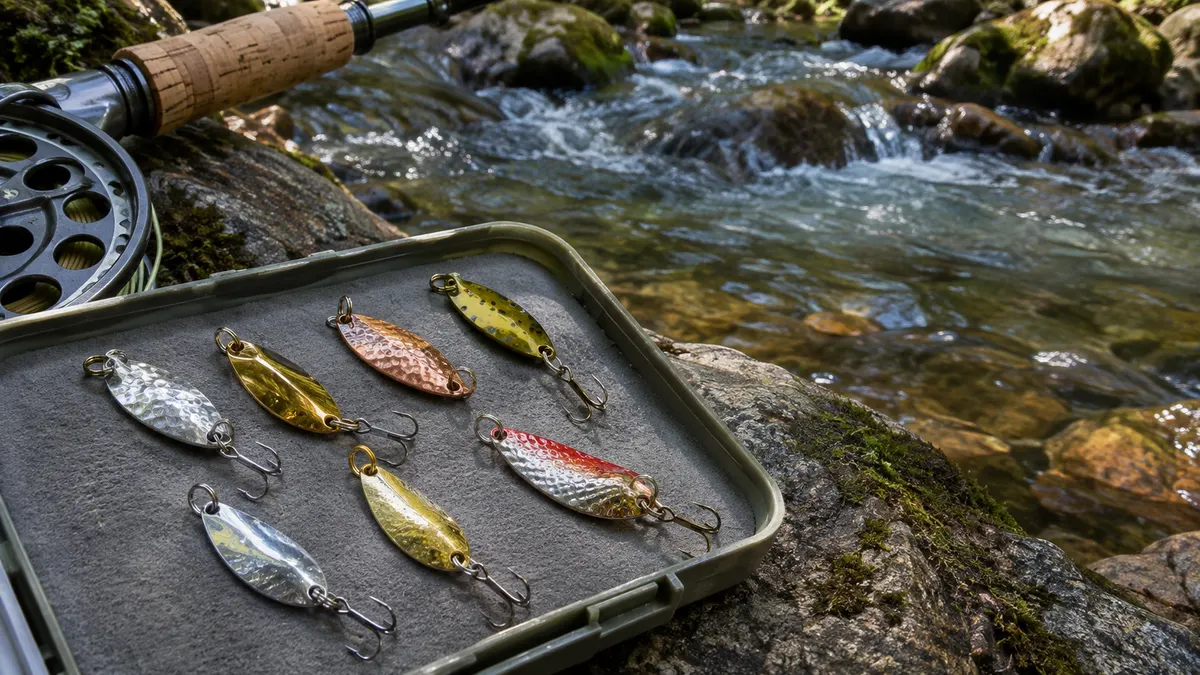
A broad, thin spoon and a compact, heavier spoon can move differently at the same retrieve speed. The shape and bend affect wobble, flutter and sink rate, while the actual weight affects how the lure casts. A spoon that spins continuously or drags bottom may need a slower retrieve, a different angle or another size.
Compare the published weight with the range printed on your rod. A very light lure can be difficult to cast on heavy line; a heavy lure can overload ultralight tackle. Our trout line guide and rod guide explain those tradeoffs.
The Acme Kastmaster is an example of a compact casting spoon. The Krocodile and Williams Wabler are other spoon families sold in multiple sizes and finishes. Compare the particular model rather than assuming that the name establishes its weight, action or hook. These examples are not claims that we have tested or ranked them.
Spoons can imitate the flash or silhouette of baitfish, though fish may respond to movement as well as appearance. A slender profile offers a different look from a broad wobbler. When comparing the Williams Wabler and Krocodile spoon, check each package for the actual weight and hook rather than assuming one size suits both trout and salmon.
Casting spoons from shore
Choose an open casting position and keep the area behind you clear. Cast across a fishable part of the shoreline, allow the spoon to sink briefly and retrieve at a steady pace. Explore shallow water first, then count the spoon down on later casts if you need more depth. Stop the retrieve before the hook reaches shallow rocks or weeds.
Silver and gold are useful starting finishes, with a darker or painted option for different light. Color is only one variable. Adjust the depth, retrieve and location before assuming another finish will catch trout. Fish may be close to shore, so do not skip the water immediately in front of you while trying for maximum distance.
Trolling and vertical jigging
A trolling spoon is pulled behind a boat at a speed that lets it work at the intended depth. Follow the lure maker’s guidance, use tackle appropriate to the fishery and keep lines clear of the motor and other boats. Local rules may restrict the number of lines or methods. Lake trout spoons intended for deep trolling can be much larger than spoons used for stocked rainbow trout.
Jigging spoons are lifted and allowed to fall vertically. Control the line on the drop and watch for a bite; the lure’s weight and action should fit the depth and conditions. Ice fishing introduces additional equipment and safety considerations. Check current ice conditions with a reliable local authority and never assume ice is safe based on appearance alone.
Hook choices and fish handling
Many trout spoons come with a treble hook; some use a single hook. Special-regulation waters may require single barbless hooks or limit the number of hook points. Check the exact rule for the water and season before fishing. If replacing a hook, use a fitting that matches the split ring and test the lure’s action; changing the hook can change how the spoon swims.
Use a rod and line that allow you to land the fish promptly. For catch and release, wet your hands, minimize handling and keep the fish in the water when practical. Carry pliers, keep hooks away from fingers and follow agency guidance if a hook is deeply embedded.
Common questions about trout spoons
Is a spoon better than a spinner?
They move differently. A spoon wobbles or flutters, while an inline spinner has a rotating blade. A spoon’s weight can be helpful for casting, but the best choice depends on depth, current and fish activity. Our spinner guide compares blade styles.
Can one spoon catch rainbow and brown trout?
Yes, a suitably sized spoon can be used for both. Match the lure and hook to the fish and the water; a large spoon for deep lake trout may not suit small stocked fish.
Can a trout spoon also catch other fish?
Yes. A small fishing lure may also attract panfish or other species in the same water. Larger spoons are used for fish such as walleye and pike, but their hooks and weight may be excessive for small trout. Follow the regulations for every species you might catch.
Do I need a swivel?
A small swivel can help manage line twist in some rigs but adds hardware. Follow the lure maker’s instructions and check that the lure swims properly. Inspect the line and knot after contact with rocks.
Before leaving, check the official stocking source for your state, public access and current fishing regulations. A stocking schedule does not guarantee fish are present in a particular spot.
Sources & further reading
- Oregon Department of Fish and Wildlife: trout fishing basics ↗
- National Park Service: How to safely catch and release ↗
Product details and fishing rules can change. Check the current listing and local regulations. Suggest a correction.