Affiliate disclosure: We may earn a commission from links on this page. As an Amazon Associate I earn from qualifying purchases.
Compare single-hook fly-style spinners with a larger inline spinner assortment. Check the selected lure weights and local hook rules; these are listing-based comparisons, not field-test results.
Trout spinners to compare
| Product | Useful for | Check before buying |
|---|---|---|
| Syffvlo single-hook trout spinner assortment | A single-hook fly-style assortment | Verify barb and hook rules |
| Fly-style trout spinner kit | A smaller fly-spinner pack | Confirm the selected style and weight |
| YPWUE inline spinner assortment | An inline spinner assortment | Check individual weights and hooks |
Syffvlo single-hook trout spinner assortment
Syffvlo single-hook trout spinner assortment
A ten-piece assortment listed with single hooks and fly-style dressing. Check hook and barb rules before use.
Check PriceThe Syffvlo listing describes ten fly-style trout spinners with single hooks. Compare it when the profile of a dressed hook and a rotating blade fits your fishing.
A single hook is not automatically legal on every special-regulation water. Check the exact hook, barb and artificial-lure rules, along with the lure weight.
Fly-style trout spinner kit
Fly-style trout spinner kit
A small spinner and fly assortment. Confirm the selected style, actual weight and hook configuration in the listing.
Check PriceThis listing describes a five-piece fly-style spinner kit. It provides a smaller assortment for an angler comparing dressed spinner profiles in a stream or pond.
The listing contains differing weight descriptions, so verify the actual selected version instead of relying on a single figure. Match the lure and hook to your rod and regulations.
YPWUE inline spinner assortment
YPWUE inline spinner assortment
A ten-piece spinner kit marketed for freshwater fishing. Check the sizes and hooks against your rod and local regulations.
Check PriceThe YPWUE listing describes a ten-piece inline spinner assortment marketed for trout and other freshwater fish. It is an alternative when you want multiple spinners to compare.
Inspect the individual weights and hook configuration before fishing. In fast current, retrieve speed and the place you cast can matter more than the number of colors in a kit.
Quick answer: which trout spinner should you choose?
For a small stream, start with a compact spinner that fits your light spinning rod and can be retrieved without scraping the bottom. For an open lake, a slightly heavier lure within your rod’s rating can help with casting distance. A silver or gold blade is a practical starting point; keep another color for different light and water conditions.
No single blade, color or brand catches trout every time. Change your depth, position or retrieve before assuming you need a large assortment. If your fishery requires single or barbless hooks, select a legal lure and check whether any modification is permitted.
How an inline spinner works
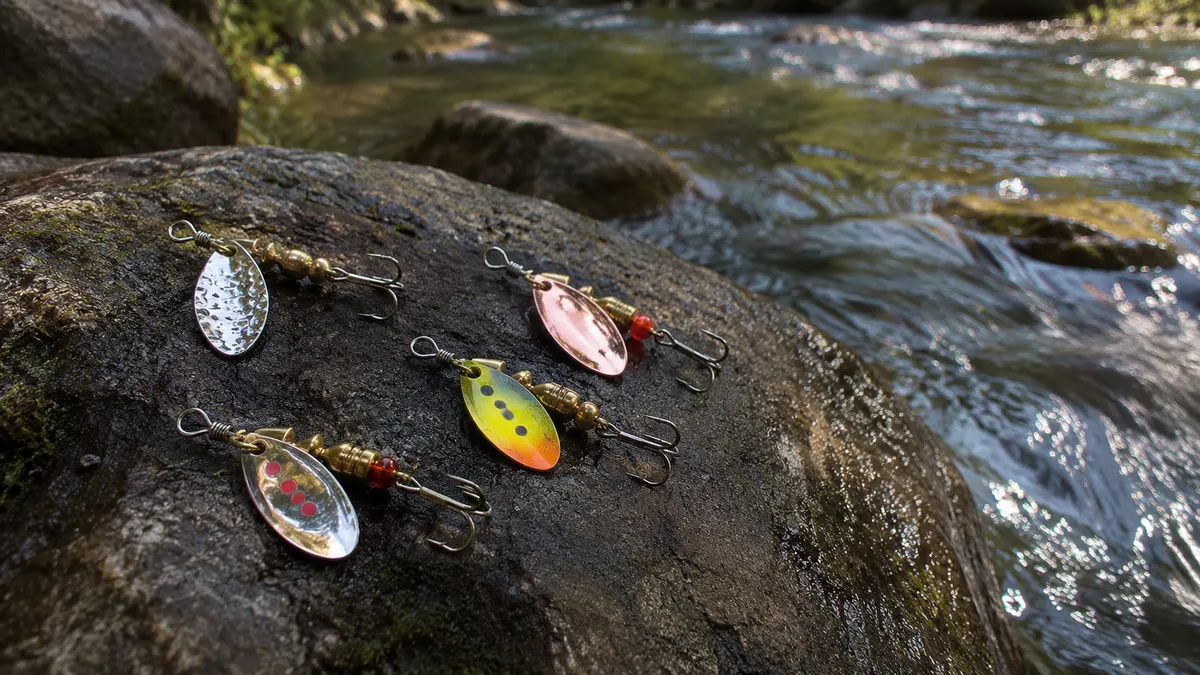
An inline spinner has a blade that rotates around a central wire as it moves through the water. That movement creates flash and vibration. Different blade shapes and mounting systems respond differently to current and retrieve speed, so a lure that works well in fast water may need a different presentation in a calm pond.
Some trout spinners have a dressed hook or fly-style tail. Others have a plain body and treble hook. A dressed hook adds bulk and a different profile; it is not necessarily better in every stream. The hook and dressing can affect how the lure swims, so check the assembled lure rather than judging the blade alone.
Well-known spinner styles to compare
The Mepps Aglia is an example of a classic inline spinner, and the Mepps Black Fury is another recognizable dressed or patterned spinner family. Panther Martin designs use a different blade arrangement. Worden’s Rooster Tail is known for its dressed tail, while the Blue Fox Vibrax is another spinner style anglers may compare. Each comes in variations; the name alone does not establish the weight, hook or legality of the version in your hand.
These are examples of widely available designs, not claims that we have tested them or that one consistently outperforms another. Compare the blade, body weight and hook, then choose the size that fits your rod and conditions. A small assortment can cover more situations if it offers genuinely different sizes rather than many near-identical colors.
For example, the Panther Martin Classic and Blue Fox Classic Vibrax names identify families with multiple sizes and finishes. When comparing a Vibrax or Aglia at a tackle shop, read the actual package rather than assuming a named model has one fixed hook. Some dressed versions use hackle or other fibers near the hook; confirm the material and any restrictions in the waters you fish.
What size and color spinners work for trout?
Check the lure weight printed on the package against the rod’s recommended casting range. A tiny spinner below that range may be difficult to cast accurately, while a heavy lure may overload a very light rod. Line diameter and wind also affect casting; see our trout line guide when setting up a reel.
In clear water and bright sun, a subdued or smaller presentation is one option to try. In darker water or low light, a more visible blade or body may be useful. Silver, gold and darker blades give you a modest range without requiring every finish on the shelf. Fish can respond differently from one day to the next, and color is only one part of the presentation.
How to fish spinners in a stream
Approach a small stream carefully and make a short cast across or slightly upstream where safe. Allow the spinner to settle briefly, then retrieve at a speed that keeps the blade turning without dragging the lure rapidly out of the fishable water. Watch for current seams, deeper pockets and cover, but avoid casting near people or onto a bank where you cannot retrieve the lure safely.
If you repeatedly snag bottom, start the retrieve sooner or select a lighter lure. If the spinner rides too high, give it more time to sink or choose an appropriate heavier weight. Keep your line clear of branches and check the knot after contacting rocks. Rainbow trout and brown trout may hold in different places as flow, temperature and cover change.
How to fish spinners in a lake or pond
In still water, cast from an open position and begin a steady retrieve. Let the lure sink for a few seconds on the next cast if you need to explore deeper water, counting consistently so you can repeat a depth that works. If it fouls weeds or hits bottom, start sooner. Pause and change angle rather than retrieving through the same unproductive path indefinitely.
A spoon is another compact metal lure that can help cover a lake, while a jig beneath a float can stay in one area longer. Spinners are search tools, not proof that fish are present. Check the official stocking source and treat planned dates as plans rather than confirmed releases.
Hook rules and fish handling
Many inline spinners are sold with treble hooks. Some waters require a single hook, barbless hook or artificial-only lure; others place limits on hook points. A single-hook spinner is not automatically legal everywhere, and scented dressing may count as bait under some rules. Read the agency’s regulation for the particular water.
If you plan to release a fish, use tackle that allows a timely landing, wet your hands and keep the fish in the water when practical. Carry pliers and minimize handling. Do not force a deeply embedded hook; follow your local agency’s guidance.
Trout spinner questions
Can one spinner work for rainbow trout and brown trout?
Yes, a small inline spinner can be used for both, but conditions, fish size and hook rules matter. Adjust the lure and retrieve for the water rather than assuming all trout feed the same way.
Can the same spinners be used for steelhead?
Some spinner families include versions sized for steelhead and other larger fish, but the small lures and light tackle used for stocked rainbow trout may not be appropriate in a strong river. Match the lure, rod, line and hook to the water and its regulations. Cutthroat trout waters can also have special release and single-hook rules.
Do trout spinners need a swivel?
A swivel can help manage line twist in some setups but adds hardware. Check the lure maker’s guidance, keep the connection appropriately small and inspect your line. If a lure twists line excessively, check that it is running correctly and is not damaged.
Are spinners better than bait for trout?
They serve different purposes. A spinner helps an angler cover water; permitted bait can remain near one spot. In an artificial-only area, check the definition of a legal lure before fishing.
Check the official source for your state, the current fishing rules and public access before travelling. Our trout lure guide compares spinners with other presentations.
Sources & further reading
- Oregon Department of Fish and Wildlife: trout fishing basics ↗
- National Park Service: How to safely catch and release ↗
Product details and fishing rules can change. Check the current listing and local regulations. Suggest a correction.