Affiliate disclosure: We may earn a commission from links on this page. As an Amazon Associate I earn from qualifying purchases.
These spinner sets offer different hook and dressing configurations for moving water. Match the actual weight to your rod and verify stream-specific rules; the selections are based on listings rather than field tests.
Stream trout spinners to compare
| Product | Useful for | Check before buying |
|---|---|---|
| YPWUE inline spinner assortment | Inline spinner assortment | Confirm lure sizes and hooks |
| Single-hook barbless trout spinner assortment | Listed single-hook barbless spinners | Check all special-water restrictions |
| Fly-style trout spinner kit | Fly-style spinner profile | Confirm selected weight and style |
YPWUE inline spinner assortment
YPWUE inline spinner assortment
A ten-piece spinner kit marketed for freshwater fishing. Check the selected sizes and hooks against your rod and stream regulations.
Check PriceThe YPWUE listing describes a ten-piece inline spinner kit. It is a comparison for an angler looking for several lures to work through current seams.
Check the actual hook and weight of each lure. The right retrieve depends on current and depth; avoid a lure that repeatedly drags bottom.
Single-hook barbless trout spinner assortment
Single-hook barbless trout spinner assortment
A five-piece set listed with single barbless hooks. Confirm the selected version and all local lure requirements.
Check PriceThe selected five-piece KMYZQDV set is listed with single barbless hooks. It may be worth comparing for waters with hook restrictions.
A single barbless hook alone does not guarantee the entire lure is legal. Verify the actual hooks, any dressing and all rules for the stream section.
Fly-style trout spinner kit
Fly-style trout spinner kit
A small spinner assortment with fly-style dressing. Verify the actual weight and hook configuration before buying.
Check PriceThis five-piece spinner listing combines a blade with fly-style dressing. Compare the profile with a plain inline spinner when choosing small stream tackle.
The listing contains inconsistent weight descriptions; verify the selected variant before choosing a rod. Check hook points and barb requirements as well.
Read the current before choosing a lure
Look for an accessible current seam, a pool edge or cover beside moving water. Trout may hold where they can avoid the strongest flow while watching food pass. Approach cautiously, keep a safe footing and avoid casting across other anglers or into places where a snag cannot be retrieved safely.
Start with a short cast. If the lure repeatedly hits bottom, retrieve sooner or use a lighter lure. If it sweeps out of the target area too quickly, change your position or presentation. A small stream can demand more accuracy than distance, and a stocked water may have different access rules from the next creek.
In a narrow run, make the first cast along the near edge before stepping into the water. In a deeper bend, work from the accessible outside edge without crossing private land or disturbing the bank. On bigger rivers, seams and pools are larger and current can be stronger; do not wade beyond your ability or after rapidly rising water.
Small inline spinners for trout streams
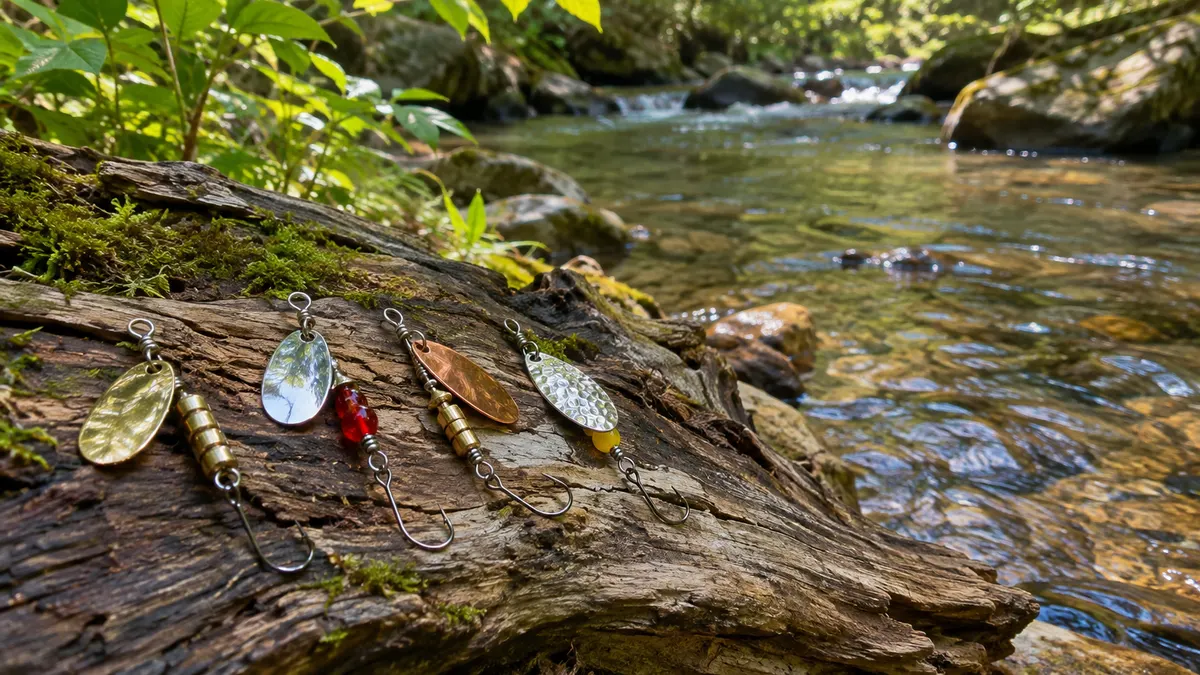
An inline spinner has a rotating blade that makes flash and vibration. Cast across or slightly upstream where safe and retrieve steadily enough for the blade to turn. Current affects the blade as well as your retrieve, so work from a position where you can keep the lure moving through the target area without dragging it rapidly downstream.
Mepps Aglia, Panther Martin and Blue Fox are examples of spinner families offered in different sizes and hook configurations. Read the package: a model name does not establish the hook type. A small spinner within your rod’s lure rating is usually easier to control in tight quarters than a large, heavy lure.
Some spinners use treble hooks; others come with a single hook. Streams with special regulations may specify single, barbless or artificial-only lures. A single barbless hook is not a guarantee that the whole lure is legal. Check the exact regulation, including whether any dressing or scent counts as bait.
Trout spinners are available in a range of sizes and colors. A compact silver or gold blade is a useful starting point; carry a darker option for different light. A Rooster Tail-style dressed spinner creates a different profile from a plain blade, while a Blue Fox spinner uses a different body design. None is a guaranteed best trout lure for every creek or condition.
Jigs and soft plastics in current
A small jig can be drifted through a pool or suspended beneath a suitable float where that method is allowed. A Trout Magnet-style jig uses a tiny weighted head and soft body. Use line and a rod light enough to cast it, and let the current carry the presentation naturally rather than jerking it through every pocket.
Soft plastics can resemble a worm, minnow or aquatic insect. Their movement depends on the weight, current and line tension. Bright colors can make a small lure easier for the angler to see; more subdued colors offer another option. Check whether scented products, including some Berkley PowerBait items, are legally classified as bait in the stream you fish.
Natural forage in trout streams can include aquatic insects and small baitfish. A worm-shaped plastic trout lure is one way to vary the profile, but a trout does not necessarily feed on the same thing throughout the year. In shallow water, adjust the jig weight and line tension so the presentation moves through the water column without dragging across every rock.
Small hard baits and spoons
A short minnow-shaped hard bait can be useful when the water is deep enough for it to work without digging into the bottom. Floating, sinking and diving models behave differently. Check the lure’s length and running depth, and use gentle twitches or pauses only when they suit the available space. Rapala makes several minnow and jerk bait styles, including the Husky Jerk; select the actual size for the stream rather than assuming the name defines one lure.
A small spoon can be cast and retrieved through a pool, but current may push it into rocks if you let it sink too long. A spoon made for a deep lake or heavy lake trout tackle may be too large for a narrow creek. Brown trout, rainbow trout and brook trout can all use current breaks, but their size and the available forage differ by water.
When fishing for wild brown trout, avoid assuming the largest lure is always best. A compact minnow or small spoon can be easier to place beside cover, while a larger hard bait may be appropriate for bigger trout in a deeper run. Keep a small tackle box with different sizes and check the hook points after contact with rocks.
Match the rod and line to the stream
A short light or ultralight spinning rod is convenient around low branches, provided the rod is rated for your lure. Look at the lure-weight and line ranges printed on the blank. A tiny lure on heavy line can be difficult to cast; a heavy lure outside the rod rating can be awkward and may overload it.
Use a reel with a properly adjusted drag, check knots after snags and carry pliers for hook removal. Our trout rod guide and line guide explain the tradeoffs. Pick up discarded line and tackle so wildlife cannot become entangled.
Stream lure or bait?
Artificial lures help an angler cover a pool or run. Natural bait or prepared floating dough can be effective where explicitly permitted, but a stream may have artificial-only, bait-free or catch-and-release rules. Read the legal definition for the exact section before bringing bait. A scented soft plastic can be treated differently from an unscented hard lure.
For a fish you intend to release, use suitable tackle to avoid an unnecessarily long fight. Wet your hands, minimize handling and keep the fish in the water when practical. Do not pull forcefully on a deeply embedded hook; follow agency guidance.
Stream trout lure questions
What lure should I try first in a small stream?
A compact inline spinner is a reasonable first choice where legal. Make a short cast, keep the blade working and adjust the retrieve for current and depth. A tiny jig can be another option for a slower presentation.
Are spinners suitable for stocked trout?
Yes, a suitably sized spinner can be used for stocked rainbow trout as well as other trout. A stocking report does not guarantee fish are still in a particular pool; check the date and source and respect other anglers.
Can I use a lake lure in a creek?
Sometimes, if its weight, depth and hook configuration fit the creek. Many lake lures are too heavy or run too deep for shallow water. Compare the actual lure rather than relying on a label.
What should I change if trout follow but do not bite?
Try a smaller trout lure, change the retrieve speed or approach the pool from a different permitted position. A spinner and a minnow-shaped hard bait move differently in current, so switching styles can change the presentation without adding scent. There is no guarantee that a change will catch trout; fish can be inactive or may simply not take the lure.
Before travelling, check the official source for your state, the current rules and access for the precise stream section.
Sources & further reading
- Oregon Department of Fish and Wildlife: trout fishing basics ↗
- National Park Service: How to safely catch and release ↗
Product details and fishing rules can change. Check the current listing and local regulations. Suggest a correction.