Affiliate disclosure: We may earn a commission from links on this page. As an Amazon Associate I earn from qualifying purchases.
A useful first fly box covers the surface, the water below it and a larger swimming profile. These three assortments offer different selections and quantities. Our comparisons use published listings; we have not independently tested the flies.
Trout fly assortments to compare
| Product | Useful for | Check before buying |
|---|---|---|
| BASSDASH 64-piece fly assortment | A larger starter assortment | Confirm patterns, hook sizes and box contents |
| Ansnbo 36-piece fly assortment | Several fly styles in a smaller kit | Check included patterns and hook sizes |
| Ventures Fly Co. 40-fly assortment | A mix of common trout fly styles | Verify pattern selection and current package |
BASSDASH 64-piece fly assortment
BASSDASH 64-piece fly assortment
A fly assortment supplied with a fly box for anglers comparing a range of patterns.
Check PriceThe BASSDASH listing describes 64 flies with a fly box for trout and bass fishing. It is worth comparing if you want several patterns in one purchase rather than selecting every fly individually.
Before ordering, inspect the listed pattern names and sizes for the waters you actually fish. A large assortment can include flies you rarely use; verify hook and barb rules and replace any damaged hooks.
Ansnbo 36-piece fly assortment
Ansnbo 36-piece fly assortment
A smaller assortment listed with dry flies, wet flies, nymphs and streamers.
Check PriceThe selected Ansnbo kit is listed with 36 flies and a box, including dry and wet patterns, nymphs and streamers. Compare it if you want to try different parts of the water without starting with a larger assortment.
Check which exact sizes and patterns are supplied. A selection that covers several styles is useful for learning, but it may not duplicate the specific hatch at your local stream.
Ventures Fly Co. 40-fly assortment
Ventures Fly Co. 40-fly assortment
An assortment listed with dry flies, nymphs, streamers and other patterns in a fly box.
Check PriceThe listing describes 40 hand-tied flies with a box, including dry and wet flies, nymphs, streamers, Woolly Buggers and terrestrial patterns. It is a comparison for someone who wants distinct surface and subsurface options.
Inspect the actual assortment and hook sizes before ordering. No kit substitutes for local regulations or knowledge of what insects are active at a particular water and time.
Start with three kinds of trout flies
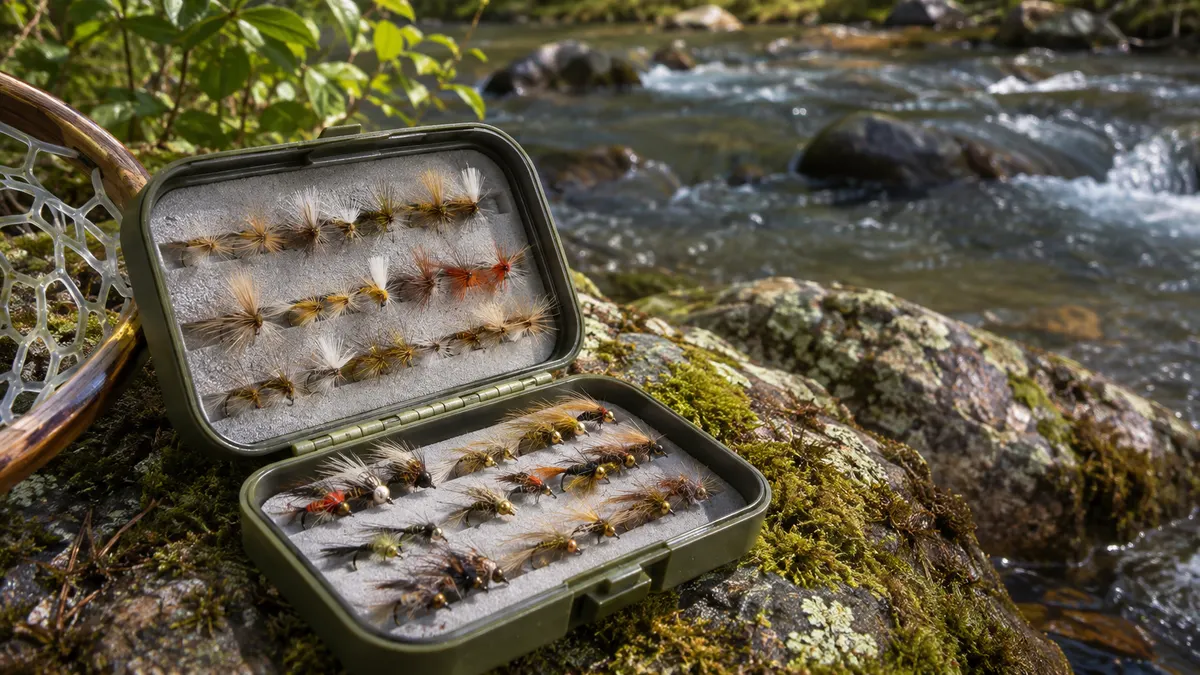
Dry flies float on the surface, nymphs are fished below it, and streamers suggest larger underwater food such as small fish or leeches. The best trout flies depend on the water, season and what fish are feeding on. Carrying a few patterns in each group gives a new angler a way to change presentation without buying every fly in the shop.
Choose hook sizes and weights that suit your rod, leader and the water. Check the exact stream rules before fishing: some areas require barbless hooks, limit the number of flies on a rig or prohibit added scent. A stocked water can have different regulations from a nearby wild trout stream.
Dry flies for surface feeding: Elk Hair Caddis and Parachute Adams
A dry fly sits on or in the surface film. An Elk Hair Caddis imitates a caddis-like silhouette, and a Parachute Adams is a versatile mayfly-style pattern. A hopper imitates a terrestrial insect that can fall into the water. These are useful starting categories, not guarantees that fish will rise to them.
Watch the water before casting. Rising fish, visible insects and the current can help you choose a fly and position. Cast upstream where safe and aim for a natural drift without pulling the fly rapidly across the surface. If the fly sinks, inspect it and follow the floatant instructions for that pattern; some materials should be treated differently.
Hatches vary by location and season. A local fly shop or agency can help identify insects, but a named hatch calendar is not proof that insects are emerging on your particular water today. Match the approximate size and shape you observe, then adjust the fly or drift if fish do not respond.
Nymphs below the surface: Pheasant Tail, Prince and Zebra Midge
A nymph represents an underwater insect stage. Common examples include the Pheasant Tail, Prince Nymph and Zebra Midge. A beadhead nymph adds weight; tungsten and brass beads of similar size can sink differently. Match the weight to the depth and current, and avoid repeatedly dragging a hook across the bottom.
An indicator or a dry-dropper setup can help track a subsurface fly where allowed. In a dry-dropper rig, a floating dry fly supports a nymph tied below it. Verify the local limit on hooks or flies before assembling one. Adjust the leader length so the nymph drifts at a useful depth without constantly snagging.
Mayfly nymphs, caddis larva, midge patterns and stonefly imitations cover different shapes and sizes. A small midge can be a useful comparison in calm water; a heavier stonefly-style pattern may be appropriate in deeper current. Read the water rather than assuming one pattern works at every depth.
The Pheasant Tail nymph is commonly used to suggest a mayfly nymph, while a Zebra Midge is a small midge pattern. A Prince Nymph has a different silhouette and is often tied with a bead. These are starting points for comparing shapes and weight, not proof that a trout will select one particular fly. If the nymph drags, adjust the leader or your position before changing the fly.
Woolly Bugger streamers and wet flies
A streamer is usually fished below the surface and can imitate a minnow, leech or other larger food. The Woolly Bugger is a familiar pattern sold in different sizes, colors and weights. Cast where safe, let it sink to a suitable depth and use short retrieves or allow current to move it. Avoid a streamer so heavy that it repeatedly catches bottom or exceeds your rod’s comfortable casting range.
Some fly fishers carry a dark Woolly Bugger and a lighter streamer so they can compare profiles in different water clarity. Let the bugger settle, then vary the retrieve while keeping enough line control to notice a bite. A streamer for a deep pool may need more weight than a fly fished in a shallow run.
Wet flies and soft hackle patterns are another subsurface option. They can be swung through a current seam with controlled line tension. A streamer for large brown trout may be much bigger than the fly needed for a small stocked pond; match the hook and leader to the fish and local rules.
Choose a fly assortment
Look beyond the number of pieces. Check whether a kit includes multiple hook sizes, whether the flies are dry or weighted and whether a storage box is included. A 64-piece assortment offers more total flies than a 36-piece kit, but the more useful kit is the one with patterns and sizes you will actually fish.
Inspect each fly before use. Make sure the hook point is sound, the eye is clear enough to tie a knot and the dressing is secure. Use a leader and tippet appropriate to the fly and expected fish. A local shop can help you replace the patterns you use most often as you learn the water.
Matching a fly pattern to the insect stage
Mayflies, caddisflies, midges and stoneflies appear in different stages. A trout feeding below the surface may take a nymph, larva or pupa, while fish rising during a hatch may be taking emerging or adult insects. A dry fly, a wet fly and a nymph present different parts of that cycle. You do not need to identify every insect precisely to begin, but observing size and behavior can guide your fly selection.
A blue-winged olive, often abbreviated BWO, is a small mayfly grouping; patterns such as a Baetis nymph are intended to suggest that profile. A caddis pupa or soft hackle offers a different subsurface shape. If a hatch is not visible, a beadhead nymph or a small streamer can help explore beneath the surface, subject to the water’s rules.
For fly fishing for trout in a fast run, use enough weight for the nymph to reach the target depth without constantly catching bottom. In slower water, a lighter fly and longer, careful drift may be easier to manage. Carry a few sizes of each fly pattern and replace damaged tippet after a snag; the most elaborate fly will not compensate for an unreliable knot.
An Elk Hair Caddis and a Parachute Adams are two classic dry flies with different silhouettes. For a larger, buoyant dry fly, compare a hopper or Stimulator with the smaller flies in your box. Below the surface, a Prince Nymph, Pheasant Tail and Zebra Midge give you several profiles; compare bead size and hook size as well as color. The best trout flies are the ones suited to the local insects and presentation, not an identical list for every stream.
Hook size is a practical part of fly selection. A size 14 mayfly imitation can be a starting point where its silhouette matches local insects; smaller midge flies may be appropriate when fish are feeding on tiny insects. Streamer flies often use larger hooks. Hook dimensions vary by pattern, so inspect the actual fly and follow local single-hook or barbless requirements.
Common trout fly questions
What flies are trout eating right now?
There is no single answer for every trout stream or stocked pond. Before choosing a fly, watch for rising fish and look at any insects on the water. A visible rise can mean a trout took something at the surface, but fish can also feed on emerging insects just below it. The rise is a clue, not a certain identification of the food.
If you see an insect, compare its size and shape with a dry fly or an emerger in your fly box. If the surface is quiet, try a nymph at an appropriate depth or a small streamer, and adjust the drift or retrieve. A local fly shop can help with current conditions; follow access rules and avoid disturbing the streambed to collect insects.
What flies should a beginner carry?
Start with a small selection of dry flies, nymphs and streamers in sizes appropriate to local waters. A Parachute Adams, a caddis-style dry, a Pheasant Tail nymph, a Zebra Midge and a small Woolly Bugger illustrate the range. Ask about current conditions rather than assuming the same five work everywhere.
How do I choose a dry fly during a hatch?
Watch for the size and shape of insects on the water and compare them with the flies in your fly box. An Elk Hair Caddis suggests a caddis, while a Parachute Adams offers a mayfly-like silhouette. A fly that drifts naturally can be more useful than an exact color match with a poor presentation.
If the fish are feeding below the film, compare a Pheasant Tail nymph or Zebra Midge with the visible insects. A beadhead adds weight, so adjust the leader and drift for the depth; use a lighter nymph if it repeatedly catches bottom. A local fly shop can help identify the current hatch and the sizes anglers are seeing.
Can flies catch stocked trout?
Yes. Stocked rainbow trout and other trout can take flies, but their behavior changes with conditions. Check the agency’s stocking report and local rules, then choose a presentation that fits the water.
On a stocked pond, a small nymph beneath an indicator or a slowly retrieved streamer can cover different depths. In a stream, a dry fly can be useful when fish are rising; observe the drift before changing patterns. Always check limits on the number of flies and hook points.
Do I need a fly rod to fish an artificial fly?
A fly rod uses a weighted fly line to cast a typically light fly. Some anglers present a fly with spinning tackle and a suitable float where legal. The rig and casting method differ, so check the water’s rules and use tackle appropriate to the fly.
Before your trip, check the official source for your state, access and current regulations. If releasing fish, wet your hands, minimize handling and keep them in the water when practical.
Sources & further reading
- Oregon Department of Fish and Wildlife: trout fishing basics ↗
- National Park Service: How to safely catch and release ↗
- Orvis Fly Fishing Learning Center: Learn by watching rises ↗
Product details and fishing rules can change. Check the current listing and local regulations. Suggest a correction.