
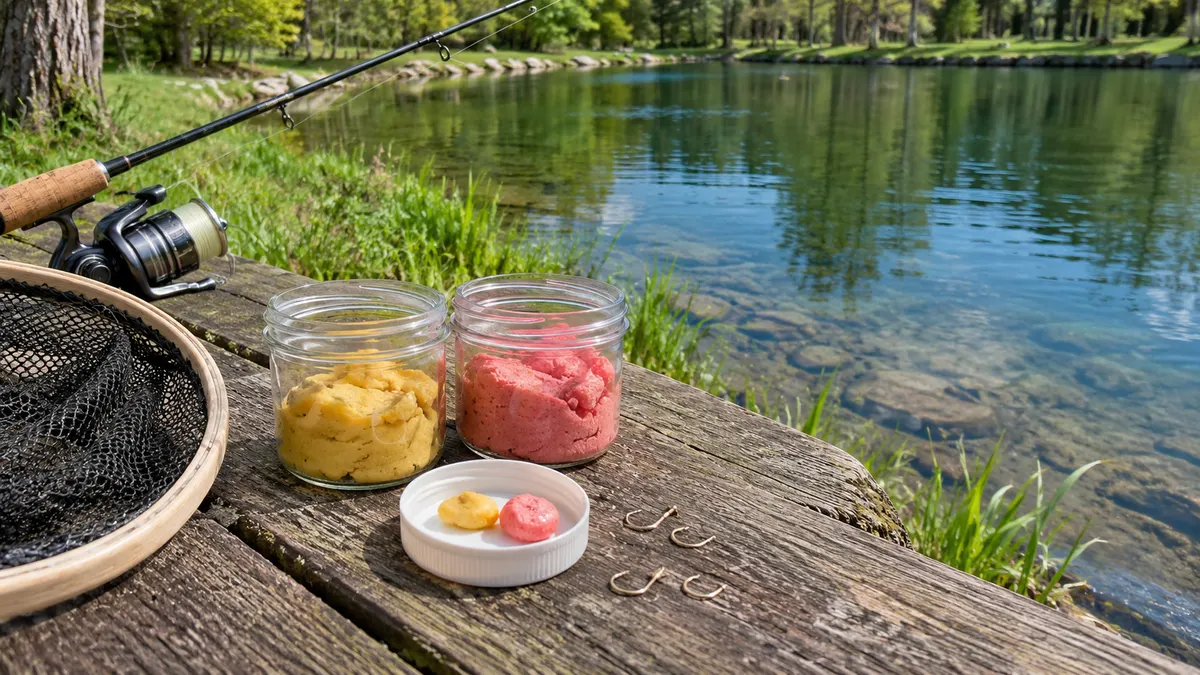
Affiliate disclosure: We may earn a commission from links on this page. As an Amazon Associate I earn from qualifying purchases.
Where bait is legal, compare a four-count dough package, one jar of chartreuse dough and floating prepared eggs. They give different package choices and bait forms; none is guaranteed to work on every trip. These comparisons use listing information rather than hands-on tests.
Prepared trout baits to compare
| Product | Useful for | Check before buying |
|---|---|---|
| Berkley PowerBait trout dough, four-pack | A multi-count dough package | Four-count listing; verify assortment |
| Berkley PowerBait Natural Glitter, chartreuse | One jar of chartreuse dough | Selected color and hook buoyancy |
| Berkley PowerBait Power Eggs, garlic rainbow | An egg-shaped prepared bait | Garlic rainbow variation; local bait rules |
Berkley PowerBait trout dough, four-pack
Berkley PowerBait trout dough, four-pack
A four-count listing of prepared trout dough. Check the exact colors, package contents and local bait rules.
Check PriceThis listing describes a four-count package of Berkley PowerBait trout dough. Verify the actual colors and package contents on the current listing before assuming it contains an assortment.
Mold a modest portion around a suitable hook and test whether it floats when assembled. Check local rules first: prepared and scented baits can be prohibited even on a water that permits some artificial lures.
Berkley PowerBait Natural Glitter, chartreuse
Berkley PowerBait Natural Glitter, chartreuse
Moldable prepared trout dough in a bright color. Rig a small portion and confirm that it floats with your chosen hook.
Check PriceThe selected Natural Glitter listing is chartreuse. A single jar can be a practical comparison if you want to start with one prepared dough rather than a multi-color assortment. The listing does not establish that chartreuse will outperform another color.
Use a small hook and check the assembled rig in shallow water. If the bait does not lift the hook, change the amount or hook size within local regulations rather than assuming every floating dough rig will behave identically.
Berkley PowerBait Power Eggs, garlic rainbow
Berkley PowerBait Power Eggs, garlic rainbow
Floating prepared bait in an egg-shaped form. Review the selected size and local bait restrictions before ordering.
Check PriceThis Power Eggs listing identifies a floating magnum bait in a garlic rainbow variation. Its prepared egg shape provides a different way to place bait on a hook from moldable dough; confirm the selected package and size.
Check whether the actual hook and number of pieces float before casting. Prepared eggs and scented dough may count as bait under local rules, so verify the exact water's restrictions and handle any fish intended for release carefully.
Quick answer: which bait for trout should you try?
Start with a small portion of floating dough when fishing a stocked pond with an accessible bottom. If fish are feeding higher in the water, a worm below a bobber lets you adjust the depth. In a stream, present an allowed bait naturally with the current rather than letting it race downstream. No bait works everywhere, and a recent stocking date does not promise a catch.
Choose your approach for the fish you intend to keep or release. Bait can be swallowed deeply, so pay attention to the line, set the hook promptly and follow the fish-handling guidance for your water. Some catch-and-release areas prohibit bait entirely.
Floating dough for stocked trout
Berkley PowerBait dough is prepared trout bait designed to be molded around a hook. Bright chartreuse and rainbow are common choices, but water clarity and fish response vary. A smaller piece can be easier for a trout to take than a large ball. Start with enough to cover the hook and test it in shallow water: the bait must support the hook to float above the bottom.
A basic bottom rig uses a sliding sinker on the main line, a swivel, a leader and a small suitable hook. Cast gently, let the sinker settle and take up slack without dragging the rig across the bottom. Leader length changes how far above the weight the bait sits. Increase it when weed or sediment hides the bait, and shorten it when the bottom is clean and fish are holding close to it. Check knots and hook restrictions before fishing.
The four-pack gives an angler a choice of colors. A single jar can be enough to start, while Power Eggs are a different prepared form. Verify the package and hook size yourself; the number of pieces needed to float a hook varies with tackle and conditions. Keep containers closed and dispose of unused material properly.
Garden worms and other natural bait
An ordinary garden worm, or a smaller piece of one, can be presented beneath a float or with a light bottom rig. Hook the worm securely without leaving so much loose material that a small fish can pull it free. With a bobber, begin at a depth that stays above weeds or rocks and adjust until you find fish.
Salmon eggs and other natural offerings are allowed on some waters but restricted on others. Live bait rules can be especially specific about species, transport and disposal. Do not move baitfish, water or unused bait between waters, and never release unused bait into the lake or stream. Read the agency’s current regulations for the particular water, not just a statewide summary.
When a lure makes more sense than bait
Artificial lures help cover water when you do not know where trout are holding. A small inline spinner works across a stream seam; a spoon can cast farther into a lake or reservoir. A jig, including a Trout Magnet, can be presented slowly under a float. A Rapala-style minnow hard bait offers a different profile. These baits and lures each need a suitable spinning rod and a retrieve matched to their weight.
Some scented soft plastics and artificial bait may legally count as bait despite being manufactured. Berkley Gulp and similar scented products should be checked against the applicable definition rather than assumed legal in an artificial-only section. Treble, single-hook and barbless rules can also change the choices available. For more on the differences, see our trout lure guide.
Common inline spinner examples include Mepps and Panther Martin designs; an Acme Kastmaster is a compact metal spoon. A nymph imitates an underwater insect stage and is often fished with fly fishing tackle. Unlike a floating trout dough rig, each of these presentations is moved or drifted to cover water. For wild trout in small streams, use a size and hook configuration that fits the water and the release rules.
Match presentation to water and fish
In a small pond, make a short cast first and watch for movement near shore. Give a stationary bait time to work, then change depth or location if there is no response. At a large lake, cover several accessible depths; a fishable drop-off can matter more than an extra color. Avoid casting into swimmers, boats or other anglers.
Prepared PowerBait dough and Power Eggs are different forms of trout bait, but both require a rig that reaches the fish. A trout angler using a bottom rig should check buoyancy with the actual hook; a bobber rig offers a way to hold permitted bait higher. A compact spinner or spoon can cover more water when fish are spread through the pond.
For a stream, use only enough weight to carry the bait naturally without repeatedly snagging. Brook trout, rainbow trout and brown trout can use different cover and current seams, and local forage changes through the season. Lake trout in deep water may require very different equipment from a stocked rainbow in a neighborhood pond. The best baits for one situation should not be treated as a universal formula.
Common questions about trout bait
What bait works for recently stocked trout?
Floating prepared dough is a reasonable starting point where allowed. A worm beneath a bobber is another option. Change the depth and position before assuming you need a different product. Stocking schedules can change; check the current state source before making a trip.
For a stocked lake or reservoir, start where bank access is permitted and present the bait at a depth clear of weeds. If trout are near the surface, adjust the float; if they are deeper, consider a legal bottom rig. An inline spinner or small spoon is an alternative when you want to cover more water.
Can I use bait for catch-and-release trout fishing?
Only where the water’s regulations allow it. Bait can increase the chance of deep hooking, so artificial lures or flies may be a better choice for a release-focused trip. Use wet hands, minimize handling and keep the fish in the water when possible.
Is a spinner better than floating trout bait?
They solve different problems. A spinner searches a larger area, while stationary floating bait can remain near one depth. Try a lure when trout are spread out, or bait when you have found an appropriate location and it is legal to use.
Some of the best trout fishing lures for covering a pond are compact spoons and inline spinners. A jig beneath a bobber can stay near one depth longer. Choose a lure weight that suits your spinning rod and check its hook configuration before fishing.
What size hook should I use?
Choose a small hook appropriate to the bait, fish and local rules. Hook sizing varies by pattern, and the buoyancy of a dough rig depends on the actual hook and bait. Test the assembled rig rather than relying on a label alone.
Before leaving, check the official stocking source and regulations for your state, confirm access, and carry the required fishing license.
Sources & further reading
- Berkley: PowerBait trout bait assortment ↗
- Berkley: Natural Glitter trout bait ↗
- Berkley: Power Eggs Floating Magnum ↗
- Oregon Department of Fish and Wildlife: trout fishing basics ↗
- National Park Service: How to safely catch and release ↗
Product details and fishing rules can change. Check the current listing and local regulations. Suggest a correction.